http://www.cnn.com/2010/CRIME/09/17/washington.acid.attack/index.html?eref=rss_topstories&utm_source=feedburner&utm_medium=feed&utm_campaign=Feed:+rss/cnn_topstories+(RSS:+Top+Stories)
Why do you lie ?
"...they had no reason to doubt their daughter's story -- as "any good parents would" -- until [she] confessed...."
Saturday, September 18, 2010

Sunday, July 25, 2010
Histrionic personality disorder - this is probably it. Does this sound like you ?
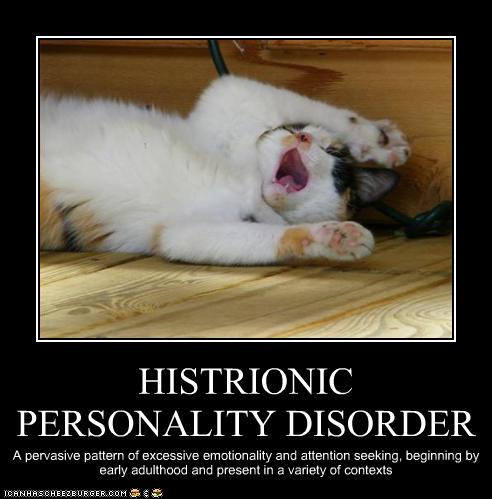
Histrionic personality disorder
You have a personality disorder characterized by a pattern of excessive emotionality and attention-seeking, including an excessive need for approval and inappropriate seductiveness, usually beginning in early adulthood. You are lively, dramatic, enthusiastic, and flirtatious.
American Psychiatric Association
You may be inappropriately sexually provocative, express strong emotions with an impressionistic style, and be easily influenced by others. Associated features may include egocentrism, self-indulgence, continuous longing for appreciation, feelings that are easily hurt, and persistent manipulative behavior to achieve your own needs.
Characteristics
You are able to function at a high level and you can be successful socially and professionally. People with histrionic personality disorder usually have good social skills, but they tend to use these skills to manipulate other people and become the center of attention.[1] Furthermore, histrionic personality disorder may affect a person's social orromantic relationships or their ability to cope with losses or failures.
People with this disorder lack genuine empathy. You start relationships well but tend to falter when depth and durability are needed, alternating between extremes of idealization and devaluation. You may seek treatment for depression when romantic relationships end, although this is by no means a feature exclusive to this disorder.
You often fail to see their own personal situation realistically, instead tending to dramatize and exaggerate your difficulties. You may go through frequent job changes, as they become easily bored and have trouble dealing with frustration. Because you tend to crave novelty and excitement, they may place themselves in risky situations. All of these factors may lead to greater risk of developing depression.
Can you tick any of these boxes ??
Additional symptoms include:
- Exhibitionist behavior.
- Constant seeking of reassurance or approval.
- Excessive dramatics with exaggerated displays of emotions.
- Excessive sensitivity to criticism or disapproval.
- Inappropriately seductive appearance or behavior.
- Excessive concern with physical appearance.
- A need to be the center of attention.
- Low tolerance for frustration or delayed gratification.
- Rapidly shifting emotional states that may appear superficial or exaggerated to others.
- Tendency to believe that relationships are more intimate than they actually are.
- Making rash decisions.
sources: http://en.wikipedia.org/wiki/Histrionic_personality_disorder
Lies and liars: psychiatric aspects of prevarication
Lies and liars: psychiatric aspects of prevarication
CV Ford, BH King and MH HollenderDepartment of Psychiatry and Behavioral Sciences, University of Arkansas for Medical Sciences, Little Rock 72205.
The authors discuss the phenomenon of lying, a common psychic process that has received remarkably little scrutiny. The ubiquity of lying and others forms of deception suggests that they have "normal" aspects, but lying which is persistent or destructive to the quality of a person's life becomes pathological. Lying has many determinants, including developmental, biological, social, and psychodynamic. Antisocial, histrionic, narcissistic, borderline, and compulsive personalities have been associated with lying. The treatment of lying needs to be individualized according to the overall symptom complex in which it is embedded.
Dr. Grubin is Professor of Forensic Psychiatry, University of Newcastle, and (Hon) Consultant Forensic Psychiatrist, Newcastle, North Tyneside, Northumberland Mental Health Trust, Newcastle-upon-Tyne, UK. Address correspondence to: Don Grubin, MD, Department of Forensic Psychiatry, St. Nicholas Hospital, Gosforth, Newcastle-upon-Tyne, UK NE3 3XT. E-mail: don.grubin@ncl.ac.uk
Lying is common, and in its many aspects forms a normal part of social interchange. In this issue, Dike et al. review the literature on what has been referred to as pathological lying, highlighting the lack of information available about this phenomenon. In this commentary on Dike et al., it is noted that if pathological lying exists, it is not the lie, but the liar that is abnormal, with the abnormality relating not to the nature of the lies told, but to the mental state associated with the behavior. Before forensic opinions regarding pathological lying can be given with confidence, we need more data to help determine whether it is in fact a psychiatric entity, and if it is, about the physical and psychological characteristics that underpin it.
Betrayal & Treachery

Betrayal of Trust
When a person feels that they have been betrayed, they may well seek some form of justice, putting right (at least for them) what they feel has been wronged, including their sensibilities.
Note that justice and fairness are different things and vary with context. From a personal view, justice means 'making me feel better'.
http://changingminds.org
Tricks and treachery
Tricks and treachery are the practice of fools, that don't have brains enough to be honest.


College Hoaxers - a Trilogy
Episode One: Azia Kim
Episode Two: Adam Wheeler
Episode Three: Mystery fraudster.
Episode One:
Azia Kim
Azia Kim was, by all reports, a sweet, church-going Korean American girl with less than stellar academics at a high-achieving Orange County high school. She had told her parents she'd gotten into Stanford, and apparently had to keep up the ruse.
Episode Two: Adam Wheeler
Episode Three: Mystery fraudster.
Episode One:
Azia Kim
Azia Kim was, by all reports, a sweet, church-going Korean American girl with less than stellar academics at a high-achieving Orange County high school. She had told her parents she'd gotten into Stanford, and apparently had to keep up the ruse.
Imposter

An impostor or imposter is a person who pretends to be somebody else, often to try to gain financial or social advantages through social engineering.
wiki
Subscribe to:
Posts (Atom)